
You walk past your thermostat every day, setting the temperature and expecting comfort. But do you ever stop to consider the conversation happening between your wallet and your HVAC unit? For most homeowners, the heating and cooling system is the single biggest consumer of energy—often accounting for more than half of the total utility bill. If your system isn’t running efficiently, you’re not just dealing with high bills; you’re losing money every single minute the unit runs.
This blog post breaks down the most common reasons your HVAC is underperforming and, more importantly, provides actionable, fast solutions to reclaim your home comfort and your savings.
- Is Your System Wasting Energy?
- The Top 3 Causes of HVAC Inefficiency
- Actionable Solutions: Fix It Fast
- Optimizing Performance
Contact Ideal Heating today for a comprehensive inspection to discover why your HVAC system is inefficient and how to fix it.
Key Takeaways
The #1 Cause: The most common and easily fixed cause of inefficiency is a lack of regular maintenance and dirty filters.
Age Matters: Systems over 15 years old are technologically outdated and cost significantly more to run than modern high-efficiency models due to lower SEER/AFUE ratings.
Sizing is Critical: Both oversized and undersized systems cause inefficiency; an oversized unit is especially problematic as it short-cycles and fails to adequately dehumidify the air.
The Envelope: Even a perfect HVAC system will struggle if your home has leaky ductwork, poor insulation, or drafts. Sealing ductwork is a high-return investment.
The Fast Fix: Replace your air filter and schedule a professional tune-up to see immediate efficiency gains.
Ideal Heating’s Role: We provide expert diagnostics, precision tune-ups, and accurate sizing (Manual J) calculations to fully optimize your system.
1. Is Your System Wasting Energy?
That surprisingly high monthly energy bill isn’t always the fault of utility rates. Oftentimes, the culprit is right in your basement or backyard: an inefficient HVAC system.
An inefficient system doesn’t just cost you money; it robs you of comfort. It struggles to maintain a consistent temperature, runs too long, and ultimately breaks down sooner.
When your system is inefficient, it means the energy it consumes isn’t being fully converted into heating or cooling power. Instead, that energy is wasted as friction, heat loss, or simply running the system unnecessarily.
You’ll notice this as short-cycling (turning on and off frequently), unusually loud operation, or hot and cold spots throughout your home.
The good news is that many sources of inefficiency can be quickly diagnosed and corrected. By understanding the common causes, you can take control of your comfort and start saving immediately.
2. The Top 3 Causes of HVAC Inefficiency
If your energy bills are creeping up, one (or all) of these factors is likely dragging down your system’s performance:
1. The Hidden Cost of Neglect (Maintenance)
The most common and most easily fixable cause of inefficiency is simply poor or absent maintenance. When components get dirty, they restrict airflow and heat transfer, forcing the unit to run longer and use more electricity.
Dirty Air Filters: A clogged filter restricts airflow, causing the blower motor to work harder. This restricted airflow, known as a high static pressure issue, can reduce efficiency by 5% to 15% instantly. Changing the filter every 1–3 months is the cheapest and most effective piece of preventative maintenance you can perform.
Dirty Coils: Over time, the evaporator (indoor) and condenser (outdoor) coils get covered in a layer of dust and grime—often called a “blanket of dirt.” This layer acts as insulation, making it incredibly difficult for the unit to exchange heat, its primary job. A technician must thoroughly clean these coils to restore their heat transfer capabilities.
Low Refrigerant: A small leak leads to low refrigerant levels, causing the unit to run constantly without properly cooling the air. Crucially, refrigerant doesn’t get “used up” like gasoline; low levels indicate a leak that must be found and repaired, not just topped off. Running a system low on refrigerant causes extreme stress on the compressor, leading to a costly failure.
2. Time and Technology (Outdated Equipment)
Technology moves fast, and HVAC is no exception. If your furnace or air conditioner is over 10–15 years old, it’s likely operating far less efficiently than a modern unit, regardless of how well you maintain it.
Older systems typically have lower efficiency ratings:
Seasonal Energy Efficiency Ratio (SEER) for air conditioners.
Annual Fuel Utilization Efficiency (AFUE) for furnaces. A 20-year-old AC unit with a SEER rating of 8, for example, is drastically less efficient than a new standard unit with a SEER of 14 or higher. The difference is compounded by advances in variable-speed blower motors and two-stage operation in new units, which allow them to run at lower, more efficient speeds for longer periods, consuming less power than older, single-speed “all-or-nothing” units.
3. The Size Doesn’t Fit (Incorrect System Sizing)
Believe it or not, a system can be inefficient if it’s too big or too small for your home. System sizing should be determined by a Manual J load calculation, which accounts for insulation, windows, climate, and more.
System Too Small: The unit has to run non-stop, never quite reaching the desired temperature. This excessive run-time leads to high bills and rapid component wear, dramatically shortening the system’s lifespan.
System Too Big: This is surprisingly common. An oversized unit “short cycles”—it cools the space too quickly, satisfies the thermostat, turns off, and then turns back on soon after. This is inefficient because the highest energy consumption occurs when the unit starts up. For air conditioning, an oversized unit also fails to properly dehumidify the air because it doesn’t run long enough, leaving you feeling sticky and uncomfortable, even if the temperature is correct. This leads users to set the thermostat even lower, compounding the inefficiency.
3. Actionable Solutions: Fix It Fast
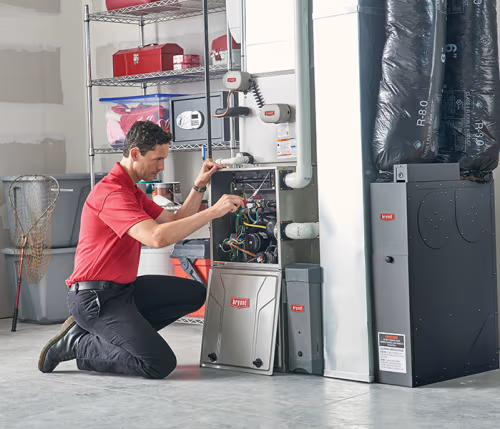
You don’t have to wait for a disaster to make changes. Here are three ways to quickly boost your HVAC performance:
Tune-Up for Immediate Gains
Schedule a professional tune-up immediately, ideally before the start of both the heating and cooling seasons. A technician will clean the coils, check refrigerant and static pressure levels, lubricate moving parts, and calibrate the thermostat to ensure accuracy. This can instantly restore lost efficiency and is essential for validating your system’s warranty.
In addition to professional service, you should also replace your air filter today. This is the fastest, cheapest fix you can perform and provides instant relief to your blower motor.
Insulation and Sealing
Your home’s envelope (the outer shell of your house) is just as important as the HVAC unit itself. Your system might be running perfectly, but if your heated or cooled air is escaping through leaky ducts, drafty windows, or poor attic insulation, you are paying to heat or cool the outside world.
Pro Tip: Have a professional check your ductwork for leaks and seal them. Leaky ducts – especially those running through unconditioned spaces like attics or crawl spaces – can lose 20–30% of the air flowing through them, essentially throwing away your conditioned air. Improving your attic insulation is another high-impact, low-stress improvement.
Consider the Upgrade
If your system is nearing the 15-year mark and requires frequent, expensive repairs, it’s time to weigh the costs. Take the cost of your repairs and your high energy bills, and compare them to the monthly savings from a high-efficiency replacement system. Modern, high-efficiency equipment—such as a Variable-Speed Heat Pump or a high-AFUE furnace—can quickly offset the initial investment. Modern systems are designed to modulate their output, running at low, energy-saving speeds most of the time, consuming less power and providing more consistent comfort than old, single-speed equipment.
4. Optimizing Performance
Diagnosing HVAC inefficiency requires expert knowledge, especially when it comes to assessing system sizing and duct performance—issues that go far beyond a simple filter change.
At Ideal Heating, we specialize in comprehensive diagnostics, offering the following services to ensure maximum efficiency:
Precision Tune-Ups: Our maintenance plans are designed to identify and correct the small issues (like low refrigerant or dirty coils) that lead to massive inefficiency and eventual failure. We use advanced tools to measure your system’s exact performance metrics.
Load Calculations: We perform accurate Manual J load calculations to ensure any replacement system is perfectly sized for your home’s specific thermal needs, eliminating both short-cycling and continuous run-time, guaranteeing maximum comfort and efficiency.
High-Efficiency Upgrades: We offer a full range of high-SEER and high-AFUE equipment with variable speed technology that can drastically lower your carbon footprint and energy bills while qualifying for available rebates and incentives.
Contact Ideal Heating today to schedule a system evaluation and start your journey toward lower energy bills and superior home comfort.
Ideal Heating: Your Partner in HVAC Efficiency and Savings
Ideal Heating understands that an inefficient HVAC system is a constant drain on your budget. Our professional technicians are fully TSSA-certified and specialize in diagnosing and optimizing the root causes of underperformance—from measuring static pressure and finding duct leaks to performing accurate system size assessments.
By partnering with Ideal Heating to optimize your system, you gain:
Maximized Efficiency: Precision tuning and calibration to restore peak performance, immediately reducing unnecessary run-time and lowering your monthly energy bills.
Expert Diagnostics: Accurate identification of hidden issues like refrigerant leaks or sizing errors that DIY maintenance can’t catch.
Peace of Mind: Confidence that your system is running safely and delivering the most comfort for the least cost.
Priority Service: Preferred treatment and rapid response times should any unexpected issue arise, saving you from stressful emergency situations.
Don’t continue to pay for wasted energy. Be proactive and secure your home’s most vital systems today. With over 35 years of experience serving customers in the GTA and a 5-star rating on Google Reviews, we provide the ideal advice.